
"I'm just not a schedule person!"
Have you ever said that? I hear it from homeschool moms all the time, usually when we're discussing lesson planning, getting organized, or trying to fit everything into an already busy day.
For some families, the thought of a detailed schedule sounds wonderful. They love knowing exactly what happens at 9:00, 9:30, and 10:15. For others, that sounds like a recipe for frustration!
One of the greatest blessings of homeschooling is the FREEDOM to organize our days around the needs of our families. We don't have to ring a bell every 50 minutes, and we certainly don't have to recreate a traditional classroom in our living rooms.
But here's something I've learned over the years: You don't have to be a schedule person to benefit from a routine!
And understanding the difference might just change the way your homeschool operates.
What's the Difference Between a Routine and a Schedule?
A schedule tells you when something happens. A routine tells you what happens next.
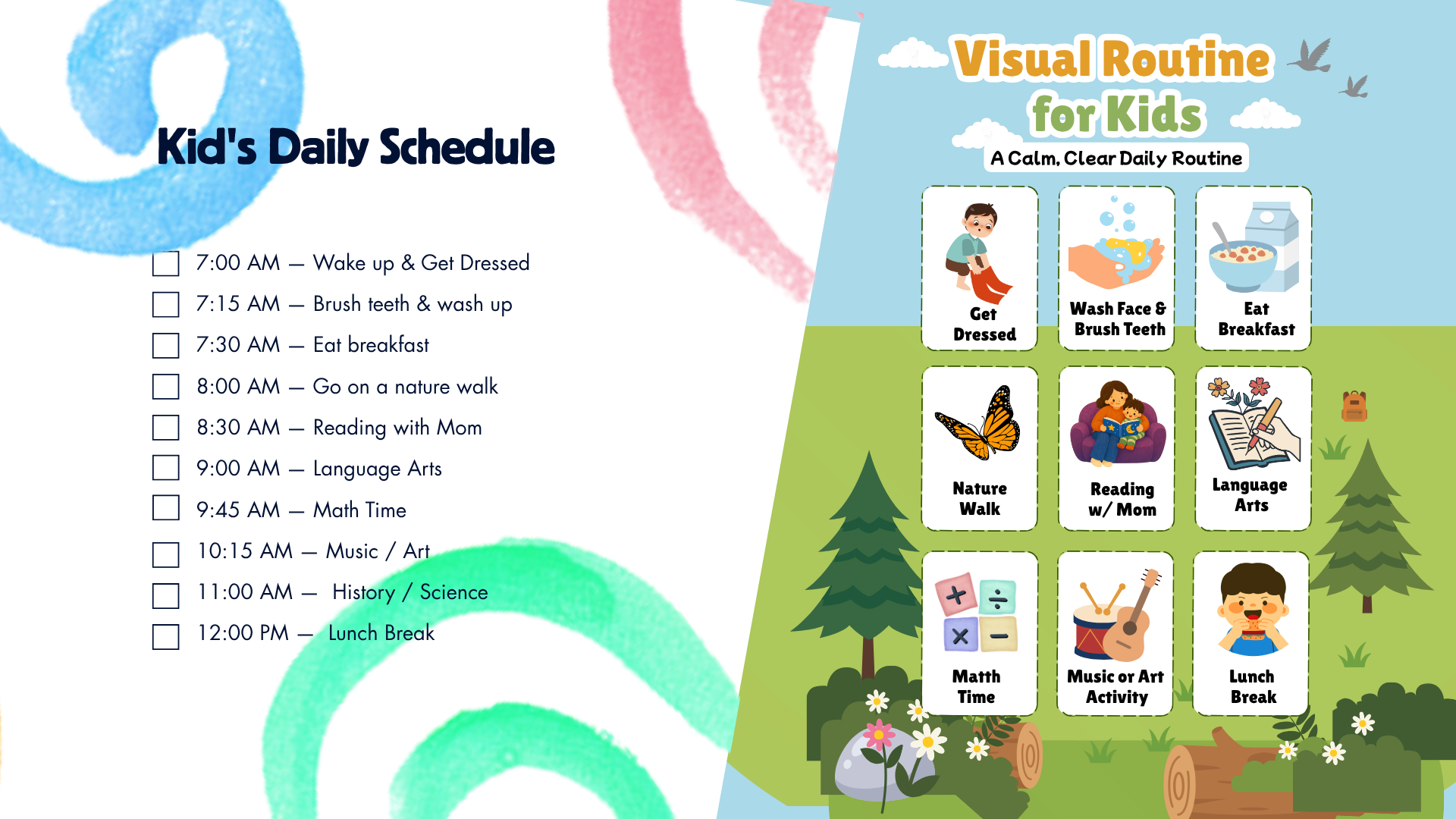
For example, a schedule might look like this:
8:30 – Bible and morning reading
9:00 – Math
9:45 – Language Arts
10:30 – Science
11:15 – Lunch
There's absolutely nothing wrong with this approach! Some families thrive with predictable time blocks, especially when juggling multiple children, outside classes, or parents' work schedules.
But what happens when math takes an extra 30 minutes because your child is struggling with a new concept? Or when a fascinating conversation breaks out during history and everyone wants to learn more?
Suddenly you're "behind schedule," and that wonderful learning opportunity can begin to feel like an inconvenience.
A routine, on the other hand, might look like this:
Breakfast → Morning Time → Math → Language Arts → Lunch → Afternoon Activities
No clock required!
You simply move from one activity to the next, adjusting the amount of time as needed.
That doesn't mean we abandon responsibility or allow every subject to stretch into eternity. It simply means we're allowing our priorities, rather than the clock, to guide the day.
Why Do Routines Work So Well?
One of the biggest challenges homeschool parents face is the constant need to make decisions. What should we do next? Have we accomplished enough? Should we stop and make lunch? When are we going to get to that science lesson?
It's exhausting!
A good routine removes some of those decisions because everyone already knows what comes next.
Here are a few benefits I've noticed:
1. Routines create predictability without rigidity.
Children generally do better when they know what to expect. A familiar routine gives them a sense of security and helps them transition from one activity to another without needing constant reminders.
2. Routines help build independence.
When your children know that math follows morning time, they can begin preparing for it without waiting for you to give directions. As they grow, this ability to manage their own responsibilities becomes increasingly important.
After all, our goal isn't just to get through another school year. We're raising young people who will eventually need to manage their own time and responsibilities!
3. Routines make room for real learning.
One of my favorite benefits of homeschooling is being able to stop and explore something interesting.
A question about a historical event might lead to a documentary, a library book, or a wonderful conversation. When we're not constantly watching the clock, we have the freedom to follow those interests.
4. Routines reduce the pressure of a difficult day.
Let's face it. Some homeschool days just don't go according to plan!
Someone wakes up sick. A younger sibling needs extra attention. A math lesson brings tears. Or maybe everyone is simply tired after a late night.
With a routine, we can slow down, make adjustments, and pick up where we left off. We haven't necessarily "failed" the day just because things didn't happen at the expected time.
5. Routines help us protect what's important.
Without some intentional structure, it's surprisingly easy for the urgent things in life to crowd out the important things.
Reading together, building relationships, praying, exploring ideas, and simply enjoying our children can all get pushed aside when we're constantly reacting to whatever comes next.
A routine helps us give those things a regular place in our day.
How Routines Have Helped Our Family
One of the BEST changes we ever made to our homeschool was establishing what we call "Morning Time."
I actually wrote about this a few years ago when we first began using a family basket, and it has remained one of my favorite parts of our homeschool journey.
The concept is simple. Instead of jumping straight into individual assignments, we begin our school day together.
Over the years, our morning time has included all sorts of wonderful things!
We typically read a biography of a missionary or historical figure, along with a fiction book. Sometimes we select historical fiction that complements the time period we're studying. Other times, it's simply a wonderful story that I want us to enjoy together.
We've also included Scripture reading, hymn learning, poetry, short stories, and even review of math facts or other things that needed a little extra reinforcement.
The beauty is that the content can change with our seasons of life, interests, and educational needs, while the routine itself stays familiar.
Sometimes our reading leads to questions and discussions that take us in completely unexpected directions. Other mornings, we simply read, enjoy the story, and move on with our day.
And that's okay!
What began as a way to bring a little more structure into our mornings has become something much more valuable.
It's been a time of reinforcement, exploration, and relationship building.
We've revisited important concepts without making everything feel like another assignment. We've explored history through the lives of real people. We've encountered new ideas, talked about difficult choices, and learned from the faith and courage of others.
And perhaps most importantly, we've spent time together.
As our children grow, their individual subjects and responsibilities become increasingly independent. That time of gathering together becomes even more precious.
Morning Time has given us a consistent way to start our day connected, rather than immediately scattering in different directions.
And notice something important: I haven't told you what TIME we start!
That's because the exact hour isn't what makes the routine valuable. It's the habit of coming together and beginning our school day with something meaningful.
Start Small and Give It Time
If your homeschool days are feeling a little chaotic, please don't think you need to sit down this weekend and create a beautiful, color-coded schedule for every hour of your week.
You might just need a simple routine.
Start by identifying one or two things that could happen in the same order each day.
Maybe everyone gets dressed and completes morning chores before breakfast. Maybe you gather for a read-aloud before beginning individual work. Or perhaps your children complete math and reading before enjoying free time.
Whatever you choose, keep it simple enough that you can actually maintain it.
And remember, routines are meant to SERVE your family, not control it.
If something isn't working, change it! If your children are growing and their needs are changing, your routines should grow with them.
There's no prize for sticking with a system that makes everyone miserable.
The Goal Isn't a Perfect Day
I think sometimes we homeschool moms put unnecessary pressure on ourselves to find the perfect curriculum, perfect schedule, or perfect system that will make everything run smoothly.
But homeschooling isn't about creating a perfectly managed classroom.
It's about intentionally educating our children, nurturing their character, building relationships, and helping them develop a lifelong love of learning.
Some days we'll accomplish everything we hoped to do. Other days, life will interrupt our plans in wonderful (or frustrating!) ways.
A good routine gives us enough structure to keep moving forward, and enough flexibility to enjoy the journey.
So, the next time you find yourself saying, "I'm just not a schedule person," remember that you don't have to be!
You may simply need a rhythm that works for YOUR family.
And sometimes, the most valuable things happening in your homeschool aren't the things you can check off a lesson plan. They're the conversations, discoveries, and relationships you're building along the way.